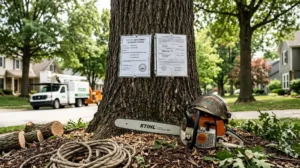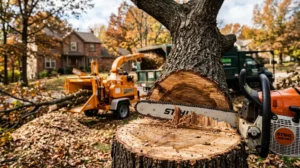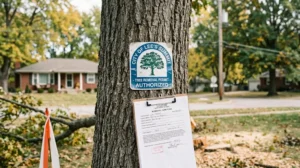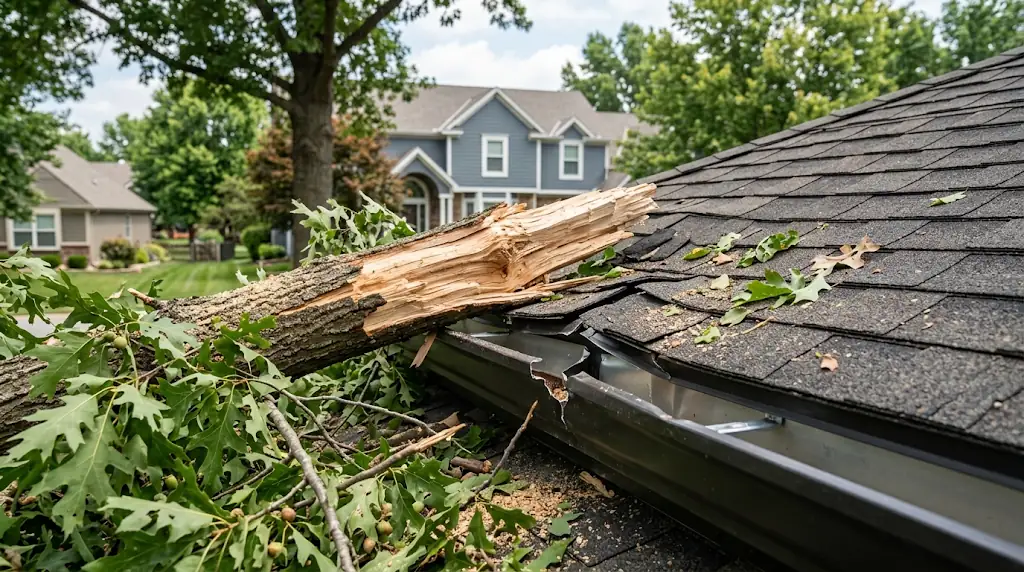
Homeowners insurance covers tree removal only if a tree falls due to a covered peril—such as severe wind, lightning, or heavy ice—and physically damages an insured structure like your house, detached garage, or perimeter fence. Policies do not pay for preventative removals, trees that fall harmlessly in your yard, or damage stemming from neglected, dead timber.
The Insurance Decision Matrix: Covered vs. Non-Covered Scenarios
Insurance carriers in Missouri distinguish sharply between structural property loss and routine yard maintenance.
| Incident Scenario | Is Tree Removal Covered? | Is Structural Damage Covered? | Standard Payout Limits & Deductibles |
| Healthy tree falls on home or garage during storm | Yes | Yes (Dwelling Coverage) | Policy pays removal up to sublimit (typically $500–$1,000 per tree) minus standard deductible. |
| Tree falls and crushes fence or detached shed | Yes | Yes (Other Structures / Coverage B) | Covered under other structures limit; tree debris sublimit applies. |
| Tree falls across driveway, blocking car access | Yes (in most policies) | No (no structure hit) | Capped at debris limit (often $500–$1,000); requires complete blockage of access. |
| Tree falls completely on open lawn or landscaping | No | No | $0. Total removal cost is an out-of-pocket homeowner maintenance expense. |
| Dead/rotting ash or oak collapses under snow/wind | No (Claim Denied) | Denied or disputed | Deemed homeowner negligence; maintenance exclusions apply. |
| Preventative removal of dangerous, leaning tree | No | N/A | $0. Insurers never fund preventative maintenance. |
3 Strict Criteria Insurers Use to Evaluate Tree Claims in Missouri
- The Covered Peril Rule: The tree must fall due to a sudden, accidental event recognized under your policy—typically straight-line thunderstorm winds, tornadoes, lightning strikes, or winter ice loading. Slow root decay, termite hollows, and pre-existing rot do not qualify.
- The “Direct Physical Impact” Threshold: In Jackson and Cass Counties, adjusters will not approve tree removal billing simply because a limb looks unsafe or touches a structure. The limb or trunk must actively compromise the structural integrity of a roof, siding, load-bearing deck, or foundational wall.
- Debris Removal Sublimits: Even when a claim is approved, insurance does not pay unlimited extraction fees. Standard policies feature a debris removal sublimit—frequently capped between $500 and $1,000 per tree, and $1,000 to $2,000 per storm event. If crane extraction costs $2,500, the policyholder covers the remaining balance out of pocket unless they have purchased an expanded debris endorsement.
City-by-City Municipal Realities & Insurance Claims
Local site conditions, power utilities, and code frameworks impact how insurance adjusters handle tree incidents across our 7 service towns.
1. Lee’s Summit, MO
- Driveway Access Nuance: Many Lee’s Summit subdivisions feature long, single-entry driveways. Insurers will cover limb removal to restore ingress and egress if an obstructed driveway traps vehicles or prevents emergency service access.
- HOA Rules: If your HOA (such as Lakewood or Winterset) requires prompt debris clearing after a storm, your insurance company still operates on its own timeline. You must mitigate damages by covering roof punctures with tarps immediately, regardless of HOA notices.
2. Blue Springs, MO
- Emerald Ash Borer (EAB) Exclusions: Blue Springs has experienced significant loss of green and white ash trees. If an ash tree dies from EAB and you leave it standing for months until a storm blows it over, adjusters will likely cite failure to maintain property and deny coverage for both structural repairs and tree removal.
3. Independence, MO
- Power Line Strikes (IPL Territory): Independence Power & Light (IPL) maintains power wires, but they do not clear trees off private structures or residential service drops. If a tree tears down the electrical weatherhead attached to your house, homeowners insurance covers the structural and electrical repair, plus the tree removal required to complete those repairs.
4. Raymore, MO
- Outbuilding & Barn Coverage: In Cass County’s semi-rural subdivisions, detached utility sheds and workshops are common. These require adequate “Coverage B (Other Structures)” limits on your policy. If your outbuilding limit is only $5,000 and a 60-foot oak destroys a $15,000 workshop, your payout caps out regardless of removal costs.
5. Lake Lotawana, MO
- Docks and Watercraft: Lakefront properties often face trees falling onto private boat docks or into shallow shoreline channels. Standard homeowners dwelling coverage rarely protects unattached docks or lifts unless endorsed under special watercraft or other-structure riders. Marine recovery of fallen wood is generally excluded from basic homeowner debris allowances.
6. Raytown, MO
- Fence Line Disputes: Raytown’s compact residential lots frequently see trees crushing chain-link or wooden privacy fences. Insurance covers fence replacement under Other Structures, but standard tree removal limits apply. If fence repair costs $800 and your deductible is $1,000, filing a claim will cost more than paying for repairs and cleanup directly.
7. Grandview, MO
- City Right-of-Way vs. Private Claims: If a municipal tree growing along a Grandview street easement falls onto your driveway, you cannot assume the city pays. Grandview municipal codes protect the city under sovereign immunity for natural storm events; you must file the removal claim through your own insurance provider.
4 Rules for Filing a Flawless Tree Removal Insurance Claim
- Rule 1: Document Before Touching Anything: Photograph the fallen tree from wide, medium, and close angles before any chainsaw cuts are made. Capture the point of impact on the structure, the root plate, and the trunk’s interior to prove the wood was healthy and fell due to wind or storm loading.
- Rule 2: Mitigate Immediately: Insurance contracts require homeowners to protect property from further damage. Hire a service to remove the structural load and install heavy-duty roof tarps. Keep all itemized receipts.
- Rule 3: Separate “Extraction” from “Disposal”: Insurance adjusters often cover 100% of the cost to lift the tree off your roof to prevent structural collapse (under Dwelling coverage), but will strictly limit the haul-away and stump grinding under the separate debris removal sublimit. Ensure your tree service itemizes these line items separately.
- Rule 4: Weigh Your Deductible Against the Bill: With Kansas City metro wind and hail deductibles frequently set at 1% or 2% of home value ($3,500 to $8,000), filing an insurance claim for a $1,200 limb removal is counterproductive. Reserve claims for major structural impacts.
When storm damage threatens your home or you need immediate tree extraction, work with a professional crew experienced in detailed insurance billing and line-item documentation. For emergency storm response and hazardous tree clearing anywhere across Jackson and Cass Counties, contact Lee's Summit Tree Removal through our contact page.