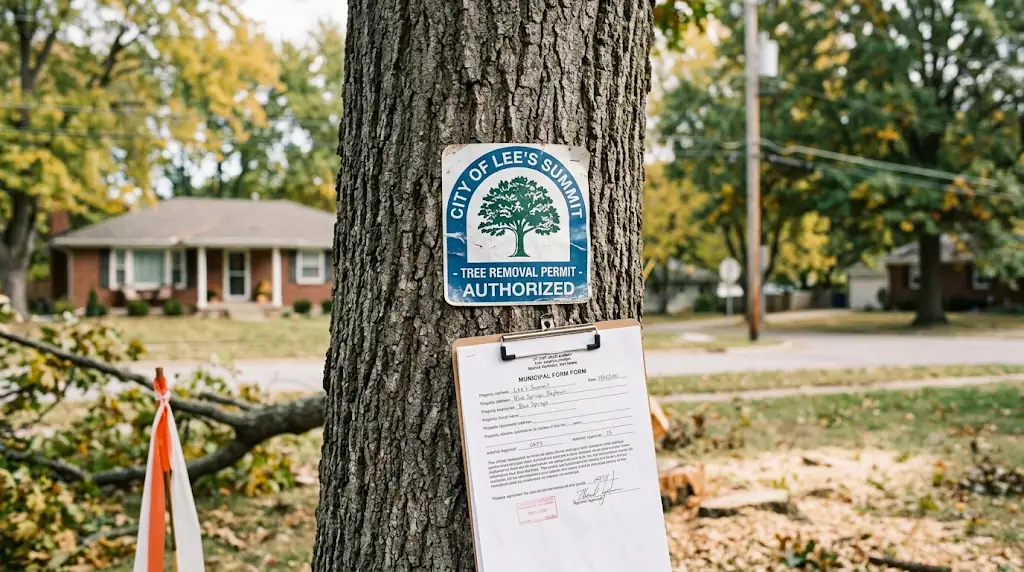
In most southeastern Kansas City metro municipalities, homeowners do not need a permit to remove a tree situated on private residential property. However, a municipal permit or administrative approval is strictly required if the tree grows within the public right-of-way, encroaches on a utility easement, sits within a designated historic district, or touches shoreline buffer zones.
Quick Reference: Tree Removal Permit Requirements by City
Every city in Jackson County and Cass County enforces distinct municipal boundaries between private land and civic jurisdiction.
| Municipality | County | Private Tree Permit Required? | Right-of-Way (ROW) Permit Required? | Governing Code / Department |
| Lee’s Summit | Jackson / Cass | No | Yes (if working in street ROW) | City of Lee’s Summit Public Works |
| Blue Springs | Jackson | No | Yes (utility & street easements) | Blue Springs Municipal Code Chapter 240 |
| Independence | Jackson | No | Yes (11-foot curb offset rule) | City of Independence Municipal Services |
| Raymore | Cass | No | Yes (commercial/greenway buffers) | Raymore Development Code Chapter 430 |
| Lake Lotawana | Jackson | No (standard lots) | Yes (shoreline/easement impact) | Lake Lotawana Association Regulations |
| Raytown | Jackson | No | Yes (public alleys/easements) | Raytown Community Development |
| Grandview | Jackson | No (exceptions apply) | Yes (Sec. 48-173 Public Works) | City of Grandview Public Works |
Detailed Municipal Tree Regulations Across the 7 Cities
1. Lee’s Summit, MO
- Private Trees: No permit is required to remove trees on private, non-commercial residential property. Property owners hold sole authority over removals outside designated conservation buffers.
- Public Right-of-Way: Under Lee’s Summit Infrastructure Maintenance Standards, property owners must maintain vegetation in the adjacent public right-of-way. However, contractors closing lanes or altering civic infrastructure during removal must secure a Right-of-Way Permit through Development Services.
- Nuisance Citations: The city issues code violations for dead hazard trees that threaten public streets or obscure traffic sightlines.
2. Blue Springs, MO
- Private Trees: Removals on private land do not require a municipal permit.
- Utility Easements: Blue Springs Municipal Code Chapter 240 regulates trees in public utility easements. Property owners and contractors cannot cut, trim, or remove trees growing over sewer, water, or drainage easements without verified utility clearance.
- Disposal Rules: Blue Springs prohibits leaving tree trunks and heavy limbs at the curb outside scheduled trash hauler collection guidelines. Restricted chemical stump removal treatments are strictly barred by municipal ordinance.
3. Independence, MO
- Private Trees: Private residential property does not require tree felling permits.
- The 11-Foot Right-of-Way Rule: In the City of Independence, the public right-of-way generally extends 11 feet inward from the edge of the street pavement. Trees inside this zone fall under City of Independence Right-of-Way Enforcement.
- Contractor Authorization: Any tree service working within Independence street corridors must be registered and obtain a right-of-way work permit from Municipal Services. Trees damaging public sidewalks require formal inspection before root severing or tree extraction.
4. Raymore, MO
- Private Trees: Detached single-family residential lots in Raymore require zero permits for tree removal.
- Commercial and Subdivision Buffers: Under Raymore Unified Development Code § 430, commercial properties, multi-family complexes, and planned developments must preserve mandatory perimeter landscape buffers. Removing required screening trees requires an updated site landscape plan submission to the Planning Commission.
- Disposal Considerations: Cass County transfer stations require separate sorting for tree logs versus commercial brush.
5. Lake Lotawana, MO
- Standard Interior Lots: Trees positioned outside community easements do not require Jackson County municipal permits.
- Shoreline and Association Limits: Lake Lotawana is an incorporated city governed in part by private parkway and lakefront covenants. Trees located within parkway reservations, along shoreline retention structures, or inside community access lanes fall under the oversight of the Lake Lotawana Association.
- Erosion Control: Clear-cutting slopes that lead to lake runoff triggers Missouri Department of Natural Resources clean-water runoff protections. Roots stabilizing lakefront retaining barriers cannot be removed without an engineering check.
6. Raytown, MO
- Private Trees: No tree removal permits exist for standard single-family residential zones.
- Hazard Violations: Raytown Code Enforcement enforces property maintenance codes regarding dangerous trees. If an owner leaves a rotting tree standing that poses an imminent collapse risk to an adjacent public pathway or neighboring dwelling, the city issues a legal summons with fines.
- Brush Dumping: Storing downed timber or unchipped brush piles on residential lawns beyond 14 days violates exterior storage regulations.
7. Grandview, MO
- Private Trees: Routine removals do not require municipal paperwork.
- Public Place Exemption: Under Grandview Municipal Code Sec. 48-173, removing or damaging any tree standing in a public street, parkway, or municipal property requires a permit from the Public Works Director.
- Historic Districts: Properties located inside designated Grandview Historic Preservation overlay districts require a Certificate of Appropriateness before altering mature front-yard canopies.
- Stump Standard: Grandview code explicitly requires public trees taken down to be flush-cut to ground level or ground below grade to prevent safety hazards.
3 Critical Scenarios Where City Permission Is Mandatory
Even when private tree work requires no basic permit, these specific legal triggers force municipal or utility intervention across all 7 towns:
- Working Near Overhead Power Lines: Missouri Revised Statutes require a minimum 10-foot safety buffer from high-voltage primary lines. Homeowners cannot hire non-utility-certified contractors to fell trees within this arc. Work requires prior de-energizing or clearing by Evergy or Independence Power & Light (IPL).
- Curb, Sidewalk, and Street Closures: If a crane, bucket truck, or chip truck must park on a public street or block a public sidewalk in Lee’s Summit, Blue Springs, or Raytown, the tree contractor must submit traffic control plans and obtain a temporary right-of-way obstruction permit.
- Homeowners Association (HOA) Covenants: Municipal law supersedes HOA rules, but HOAs enforce binding civil contracts. Planned developments across Lee’s Summit (e.g., Lakewood, Raintree) and Raymore (e.g., Creekmoor) require Architectural Review Committee (ARC) approval before removing any live tree exceeding 6 inches in trunk diameter.
Navigating Property Line Trees Under Missouri Law
- Sole Ownership: Trunk base sits 100% inside your property boundary markers. You make all decisions and fund all removal costs.
- Boundary Trees: Trunk base crosses the surveyed property line. Under Missouri state common law, the tree is common property owned jointly by both neighbors. Unilateral removal without neighbor consent constitutes actionable property trespass and destruction.
- Overhanging Limbs: You possess the legal right to prune branches crossing your boundary up to the vertical property line, provided the cuts do not destabilize or kill the tree.
Navigating municipal codes, utility easements, and technical felling requires experienced, fully insured tree professionals. To schedule an evaluation for safe, compliant removal anywhere in our service area, reach out to Lee's Summit Tree Removal today through our contact page.