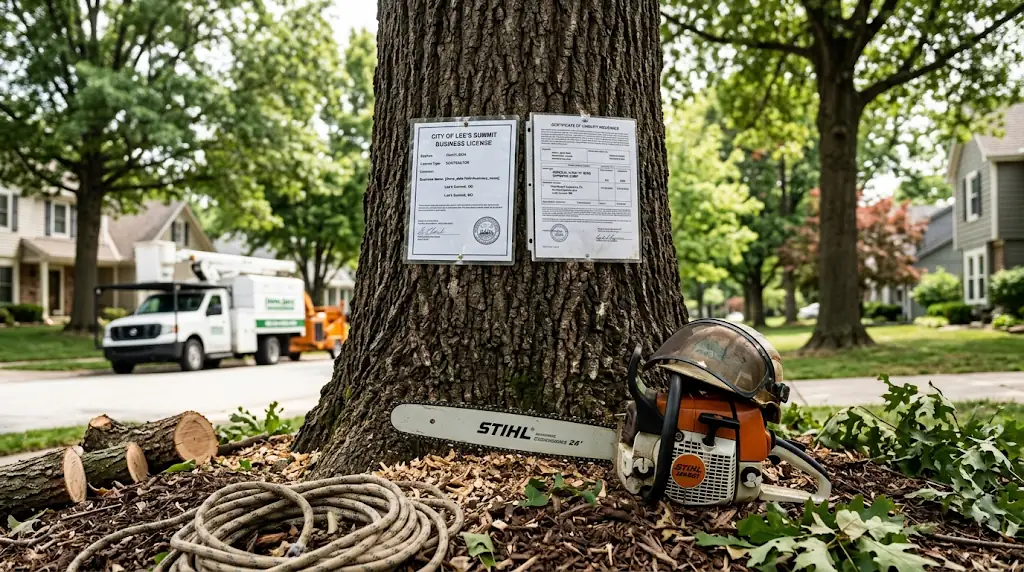
To choose a legitimate tree service in the southeastern Kansas City metro, verify active municipal business licensing in the specific city where the work occurs, demand a Certificate of Insurance sent directly from their carrier showing at least $1,000,000 in General Liability, and confirm statutory Missouri Workers’ Compensation coverage. Hiring an unlicensed or underinsured operator leaves the property owner personally liable for catastrophic property damage, severe utility disruptions, and costly worker injury claims.
The Verification Checklist: Legitimate Pro vs. Unlicensed Operator
Tree work ranks among the most hazardous professions in the United States. Cutting corners on contractor vetting exposes homeowners to massive financial risks.
| Credential / Requirement | Minimum Standard for SE KC Metro | What It Protects Against | How Homeowners Must Verify |
| Municipal Contractor / Business License | Active license in Lee’s Summit, Blue Springs, Independence, etc. | Unqualified “fly-by-night” transient crews; city code violations. | Check municipal business license registries or call the city clerk. |
| Commercial General Liability | Minimum $1,000,000 to $2,000,000 per occurrence. | Crushed roofs, cracked driveways, severed utility feeds, damaged neighbor fences. | Request a Certificate of Insurance (COI) sent directly from the broker. |
| Missouri Workers’ Compensation | Mandatory for employers with 5+ workers (or 1+ in construction). | Personal homeowner lawsuits if a tree climber or ground worker is injured on-site. | Verify statutory coverage on the certificate; never accept verbal waivers. |
| Professional Arborist Credentials | ISA Certified Arborist on staff / TCIA Accreditation. | Improper pruning, destabilizing cuts, improper felling rigging. | Verify arborist number via the International Society of Arboriculture (ISA). |
| Equipment & Vehicle Insurance | Commercial Auto & Inland Marine equipment policies. | Heavy grapple trucks or chip trailers causing street or turf destruction. | Included on standard commercial insurance certificates. |
Why Local City Licensing Actually Matters Across Our 7 Towns
Many homeowners assume that a state LLC filing or a generic county registration grants blanket authority to fell trees across the Kansas City metro. In Missouri, municipalities operate under home-rule police powers, requiring independent licensing and local insurance verification before a company operates within city boundaries.
1. Lee’s Summit, MO
- Local Code Standard: Tree services operating within Lee’s Summit must maintain an active business and contractor license through Development Services.
- Insurance Mandates: The City of Lee’s Summit requires verified certificates of insurance on file with designated liability minimums before issuing permits or contractor authorization.
- Civic Protection: Unlicensed contractors caught working inside city limits face stop-work orders and municipal court citations, leaving half-felled trees stranded on your property.
2. Blue Springs, MO
- Right-of-Way Enforcement: Blue Springs enforces strict occupation licensing. Contractors working near public rights-of-way or city drainage and utility easements must prove valid licensing and adequate bonding to protect civic infrastructure.
3. Independence, MO
- City Registration & IPL Coordination: Independence requires contractors operating in the city to hold a current city business license. When tree work interfaces with Independence Power & Light (IPL) electric infrastructure, only verified, licensed contractors can coordinate safe line drops or access city-owned utility alleys.
4. Raymore, MO
- Cass County Enforcement: Because Raymore sits in Northern Cass County outside the Jackson County court system, transient operators often cross county lines claiming broad metro licensing. Raymore code requires local business registration. Hiring licensed operators guarantees compliance with local residential noise ordinances and restricted heavy-truck residential street parking limits.
5. Lake Lotawana, MO
- Association & Municipal Scrutiny: Lake Lotawana’s unique terrain demands specialized equipment. The Lake Lotawana Association and municipal authorities require strict contractor compliance to prevent damage to private lake parkways, shoreline seawalls, and narrow winding access lanes.
6. Raytown, MO
- Nuisance & Code Compliance: Raytown code enforcement monitors tree operations closely to prevent illegal brush accumulation on residential lots. Licensed contractors maintain authorized commercial dumping accounts, ensuring large-diameter logs and brush piles do not sit in your yard drawing municipal code violation notices.
7. Grandview, MO
- Public Works Standards: Under Grandview Municipal Code Chapter 48, tree operators working near street corridors, public ways, or parkways must hold verified municipal authorization. Contractors lacking proof of insurance are barred from staging equipment on city streets.
The Danger of “Workers’ Comp Exemptions” in Missouri
The single greatest financial trap for homeowners is the “Ghost Policy” or sole-proprietor Workers’ Compensation exemption.
- The Law: Under Missouri Revised Statutes Chapter 287, employers in the construction and tree care sector with one or more employees must carry Workers’ Compensation insurance.
- The Loophole Operators Use: Low-cost contractors often claim they are exempt because they use “independent 1099 subcontractors” or work as sole proprietors.
- The Homeowner’s Real Risk: If an uninsured sub-contractor or day laborer falls from a 60-foot oak tree in your backyard, Missouri case law allows that injured worker to sue the hiring entity—which defaults directly to you, the property owner. Your standard homeowner’s policy medical payout limit ($100,000 to $300,000) will be instantly exhausted by catastrophic trauma injuries, exposing your personal home equity and savings to legal attachment.
4 Essential Questions to Ask Before Signing a Tree Removal Contract
- “Can your insurance agent email me a Certificate of Insurance listing my name and address as Certificate Holder?”Why this matters: Anyone can print a fraudulent, expired PDF certificate. When the insurance agency sends the document directly, it guarantees active, enforceable coverage. Listing yourself as the certificate holder ensures you receive formal notice if the policy cancels mid-job.
- “Does your General Liability policy include a specific Tree Care / Tree Trimming endorsement?”Why this matters: Generic landscaping policies frequently carry explicit exclusions for tree work performed above 12 or 15 feet off the ground. If an operator drops a limb through your roof from 40 feet up, a basic lawn-care policy will deny the claim.
- “Do you have an active business license registered with our specific city?”Why this matters: Legitimate services hold active licenses across all target municipalities—from Lee’s Summit and Blue Springs down to Raymore and Grandview.
- “What specific equipment will access my yard, and who pays for lawn or concrete repair?”Why this matters: A 50,000-pound knuckle-boom crane or grapple truck can crack thin suburban driveways or crush underground irrigation and sewer laterals. Professional crews utilize heavy-duty composite ground protection mats and outline structural access terms directly in their written estimate.
Never gamble your property or financial security on uninsured crews or high-risk operators. Lee's Summit Tree Removal delivers complete municipal compliance, transparent written estimates, and comprehensive liability and workers’ compensation coverage across Jackson and Cass Counties. For safe, verified tree removal, contact our team today through our contact page.