Unlike inland residential lots where homeowners hold unilateral control over their timber, lakefront tree removals around Lake Lotawana are strictly governed by deed-restricted parkway easements, association approvals, and shoreline erosion standards. Removing or trimming a tree on or near the Lake Lotawana waterfront without authorized permits can trigger substantial association fines, mandatory replacement mitigation, and legal property restoration mandates.
Lake Lotawana vs. Standard Residential Subdivisions: Quick Comparison
| Regulation Category | Standard Suburban Lots (Lee’s Summit, Raymore, Blue Springs) | Lake Lotawana Waterfront & Parkway Parcels |
| Private Removal Permits | None required on private land outside city rights-of-way. | Private permit required if tree sits in or touches association parkway easements. |
| Dead Tree Handling | Homeowner cuts and removes at will. | Owners cannot unilaterally fell dead trees on the parkway; the Association retains legal authority. |
| Neighbor Notification | Neighbor approval is not legally required for trees on private property. | Formal neighbor notification or sign-off is required for parkway alterations. |
| Erosion & Shoreline Control | Standard grading controls apply only to active construction sites. | Stringent shoreline stabilization and seawall root-integrity guidelines apply. |
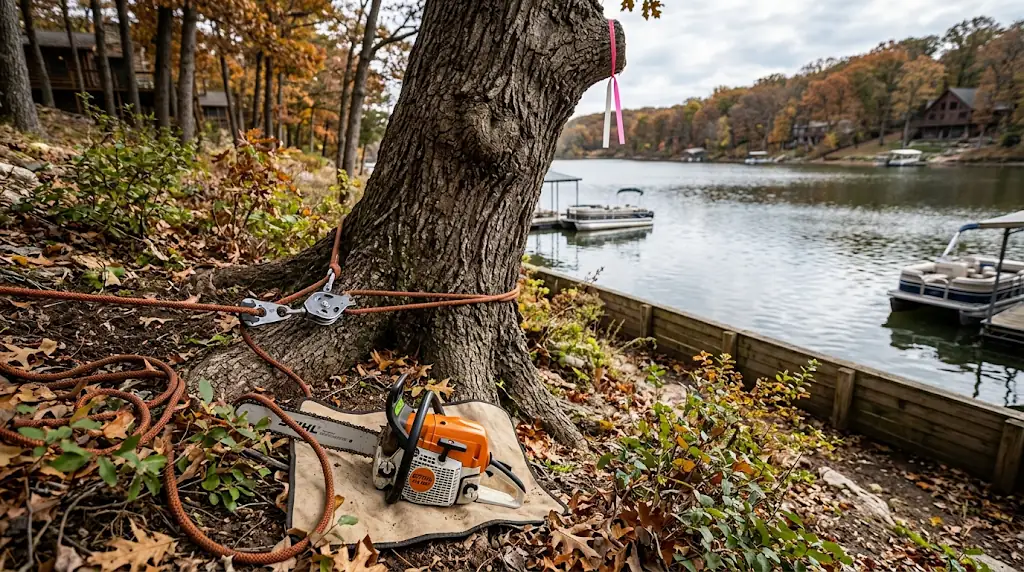
| Access & Rigging Method | Bucket trucks, compact loaders, and road cranes in wide driveways. | Specialized backyard crane setups, technical rope-rigging, or marine barge extraction. |
| Debris Disposal | Standard yard waste haulers or private contractor chipping. | Controlled drop-off at designated sites (e.g., the Association Martin Property for 4-foot logs) or complete contractor haul-away. |
3 Critical Waterfront Regulations Unique to Lake Lotawana
1. The Parkway Easement Rule
In most standard residential subdivisions—such as those in Grandview or Raytown—a homeowner’s deed extends directly to the street curb or an adjoining neighbor’s fence. Lake Lotawana is structured differently.
A large portion of the lakefront perimeter is classified as the Parkway—common ground owned and managed by the Lake Lotawana Association.
- Even if a tree stands immediately in front of your dock or deck, you cannot cut down or trim live trees on the parkway without written approval from the Association and adjacent neighbors.
- Dead trees on the parkway belong to the Association. Homeowners are barred from taking a chainsaw to standing dead timber on parkway land; the Association’s inspector must review the tree and authorize its removal.
2. Shoreline Stabilization and Seawall Protection
On standard inland lots across Independence or Blue Springs, root systems can be ground down without concern for body-of-water hydrodynamics. At Lake Lotawana, tree root plates frequently anchor the riprap, natural stone, or concrete seawalls that prevent shoreline collapse.
- Completely extracting or aggressively grinding large roots near the water line destabilizes the shoreline embankment.
- Severe mechanical disruptions along the water’s edge can trigger water-quality and runoff scrutiny under Missouri Clean Water regulations.
- Tree work on retaining walls or shoreline structures often requires coordination with the Association’s Lake Improvement Board (LIB) through the Lake Lotawana Association Permitting Process.
3. Debris Disposal Limitations
Standard residential subdivisions permit curbside limb bundles up to specific municipal hauler dimensions. Lake Lotawana enforces strict exterior disposal:
- Debris cannot be discarded into the lake, swept into coves, or stored on shoreline docks.
- Lake Lotawana Association members have access to the Martin Property Brush & Yard Waste Drop-off, which strictly limits limbs and trunk wood to sections cut to 4 feet in length or less.
- Large-scale tree removals produce tons of dense hardwood, requiring a commercial tree service capable of complete on-site chipping and hauling up steep residential roads.
Logistical Realities: Standard Lots vs. Lake Lotawana Lots
| Operational Factor | Standard Suburban Lot (e.g., Lee’s Summit or Raymore) | Lake Lotawana Lakefront Lot |
| Equipment Access | 60-to-100-foot paved driveways, wide side-yard gate access. | Narrow, winding roads; steep downhill grades; rock bluffs; zero side-yard clearance. |
| Heavy Machinery Risk | Light ground matting prevents cosmetic lawn rutting. | Heavy equipment can fracture underground septic pipes, lake access paths, or retaining walls. |
| Target Zones | Open grass drop zones, basic fence and roofline rigging. | Docks, boats, boat lifts, seawalls, narrow water channels, and multi-tier decks. |
| Alternative Extraction | Street-parked grapple and chip trucks. | Technical block-and-tackle zip lines, mini-skid steers with turf tracks, or water barges. |
How Neighboring Towns Compare to Lake Lotawana
Understanding how standard municipal policies contrast with Lake Lotawana highlights why lakefront removals require dedicated planning:
- Lee’s Summit: Governed by standard municipal zoning. Homeowners manage their trees freely on private lots. Permits are only triggered if work obstructs public street rights-of-way.
- Blue Springs: Enforces utility easement protections via Chapter 240, but does not regulate private canopy removal or lakefront preservation zones on private land.
- Independence: Focuses on street right-of-way boundaries (the 11-foot offset rule). Lakefront environmental buffer reviews do not apply.
- Raymore & Grandview: Residential tree owners carry full jurisdiction over their private land, with no association or waterfront boards overseeing tree removal outside specific commercial perimeter landscape buffers.
- Raytown: Manages dead trees strictly as private property maintenance nuisances, requiring no natural resource preservation reviews prior to cutting.
4 Steps to Removing a Lakefront Tree at Lake Lotawana
- Confirm the Boundary Survey: Determine whether the tree base rests within your private deeded lot or crosses into the Association parkway easement.
- Contact the Association Inspector: If the tree is dead, dying, or sits on parkway ground, submit an application to the Association inspector before scheduling any tree cutting.
- Notify Adjoining Neighbors: Obtain written neighbor consent for parkway trimming or removals to satisfy Association requirements.
- Hire a Marine-Experienced Tree Service: Standard street-side tree services lack the technical rigging, compact track equipment, and lake-access insurance needed to maneuver around docks, steep bluffs, and shoreline infrastructure.
Whether you need a hazard tree lowered away from a lakefront dock or a standard residential tree removed in Lee’s Summit, Blue Springs, or Independence, hire a team equipped for complex rigging and local code compliance. Contact Lee's Summit Tree Removal today through our contact page to schedule a site evaluation.