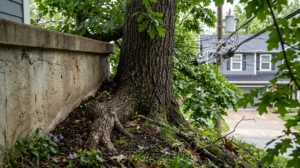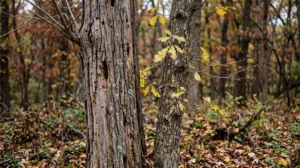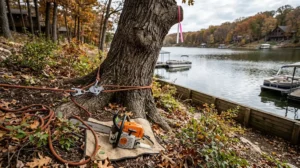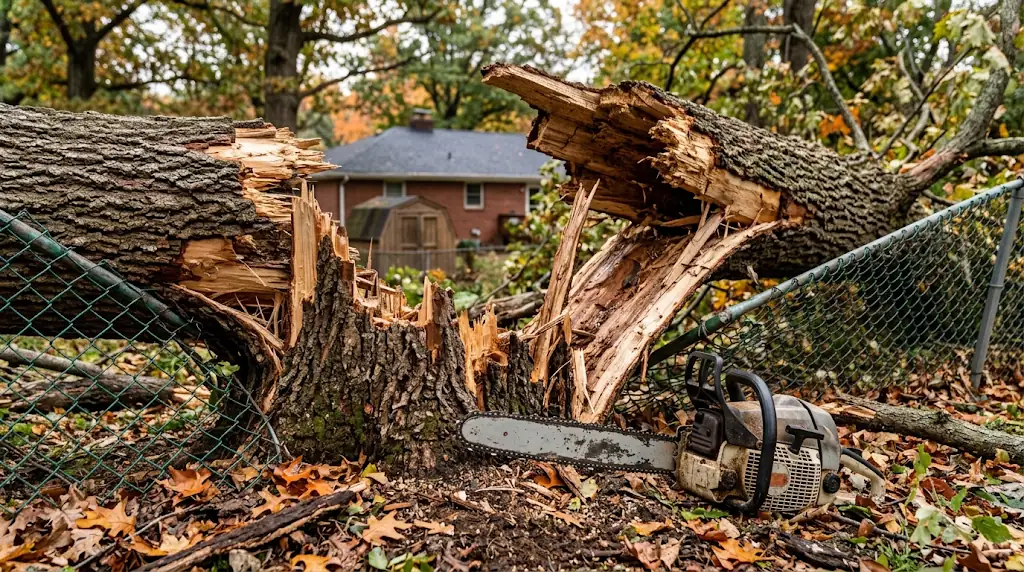
Under Missouri law, cleanup responsibility and property damage fall entirely on the owner of the property where the tree lands, regardless of whose yard the trunk was rooted in. The tree’s original owner is only legally responsible if the fallen tree was visibly dead, rotting, or compromised prior to the failure and they failed to act after receiving documented notice.
The Missouri “Act of God” Rule vs. Landowner Negligence
Missouri courts operate under common law property doctrines when adjudicating fallen tree disputes. The default legal presumption categorizes severe weather events—such as summer derechos, high prairie winds, and winter ice accumulation—as an “Act of God”.
| Condition of Tree Before Falling | Legal Classification | Who Pays for Removal & Damage? | Insurance Handling |
| Healthy, Living Tree (Felled by wind/ice) | Act of God (Non-negligent) | The neighbor whose property the tree fell onto. | Affected owner files on their own homeowner’s insurance. |
| Dead / Visibly Diseased Tree (No written notice) | Probable Act of God | The neighbor whose property the tree fell onto (negligence unproven). | Affected owner’s insurance pays minus deductible. |
| Documented Dead Hazard (Prior written notice) | Landowner Negligence | The tree’s owner where the base originally stood. | Affected owner’s insurer subrogates against neighbor’s policy. |
| Boundary Tree (Trunk straddles property line) | Joint Tenancy / Shared Property | Both property owners share removal costs equally. | Both policies split structural or debris claims. |
3 Core Boundary Scenarios in Missouri Law
1. The Tree Stood Wholly on Your Neighbor’s Lot
If a healthy 70-foot oak tree anchored in your neighbor’s yard snaps during a storm and lands across your lawn, driveway, and roof, your neighbor is not legally responsible for removing the debris from your lot. Missouri property law mandates that what lands on your property becomes your responsibility to manage.
- You cannot push, toss, or drag fallen limbs back across the boundary line onto your neighbor’s yard. Doing so constitutes civil trespass under Missouri common law.
- Your neighbor is only responsible for the portion of the tree that remains on their side of the survey boundary.
2. The Exception: Proving Negligence
To transfer financial liability to the tree owner, you must establish clear legal negligence. In Jackson and Cass Counties, this requires meeting three rigorous criteria:
- The tree was structurally compromised, rotting, diseased, or dead prior to the incident.
- The tree owner had actual or constructive notice of the hazard (e.g., an ISA Certified Arborist evaluation or a formal, dated notice).
- The owner failed to take reasonable remediation steps within a practical timeframe.
Without prior written documentation—such as certified mail or a recorded municipal code enforcement complaint—Missouri courts treat storm failures as unavoidable natural events.
3. Boundary Trees (Dual Ownership)
A boundary tree exists when the base trunk of the tree physically straddles the surveyed property line.
- Under Missouri law, both adjoining landowners hold joint tenancy over boundary trees.
- Neither neighbor may unilaterally cut down or destabilize a healthy boundary tree without the other party’s written consent.
- Under Missouri Revised Statutes § 537.340, an individual who cuts down or destroys a jointly owned tree without authorization can face civil liability for treble (triple) damages.
- When a boundary tree falls, both owners must split the clean-up and disposal costs equally for shared sections.
How Responsibility and Enforcement Vary by Town
While Missouri state law dictates property torts, municipal nuisance and vegetation codes govern local code enforcement across our service footprint.
Lee’s Summit
Lee’s Summit Code Enforcement enforces strict nuisance codes for fallen timber. If a fallen tree blocks public sidewalks, pedestrian trails, or street lines of sight, the city gives the property owner where the tree is grounded 10 to 14 days to clear the hazard before assessing municipal abatement fines.
Blue Springs
Blue Springs requires debris clearance when fallen trees obstruct drainage ditches or public easements. Homeowners whose lots receive fallen trees across residential easements are responsible for private contracted removal, as city crews will not enter private property to retrieve wood.
Independence
Independence operates its own municipal utility, Independence Power & Light (IPL). If a neighbor’s fallen tree downs a service drop (the wire connecting the pole to an individual home), IPL will clear the wire, but the property owner must hire a tree service to remove the wood from their own yard and repair their home’s electric weatherhead.
Raymore
In Cass County, high winds regularly drop softwoods like Bradford pears. Raymore municipal regulations prohibit burning yard timber within standard subdivisions. Both neighbors must arrange haul-off or chipping through a licensed tree service, as curbside municipal collections exclude tree trunks and heavy boughs.
Lake Lotawana
Fallen trees impacting lake access, shoreline retention walls, or parkway easements trigger shared review under Lake Lotawana Association guidelines. If a tree falls into the water across dock lines, immediate recovery is mandatory to prevent boating hazards. The cost falls on the party responsible for the slip or parcel where the debris rests.
Raytown
Raytown enforces clear limits on long-term yard debris storage. Property owners must remove storm-felled logs within 14 days. Neighbors cannot leave storm wood sitting on their side of the fence line indefinitely without drawing municipal property maintenance citations.
Grandview
Grandview Public Works does not clear storm-felled trees unless they land in public rights-of-way, city parkways, or municipal drainage corridors. Homeowners are fully responsible for limbs falling onto private structures, driveways, or fences.
Step-by-Step Action Plan for a Fallen Property Line Tree
- Document the Damage Immediately: Take wide-angle and close-up photographs showing the tree’s root base, trunk condition, and where the trunk crosses the boundary line.
- Contact Your Homeowner’s Insurance Company: File a claim with your own insurance carrier first. Your insurer handles structural repairs and debris removal minus your deductible.
- Notify the Insurer of Pre-Existing Hazards: If you previously sent written notice to your neighbor regarding a dying tree, provide that correspondence to your claims adjuster. Your insurance company will pursue the neighbor’s carrier through subrogation.
- Hire an Insured Tree Removal Crew: Never attempt to section trees under tension or trees resting on boundary fences yourself. Chain saws catch and whip when logs roll under load.
Whether you need emergency storm clearance, hazardous limb rigging, or an impartial tree risk evaluation across Jackson or Cass County, Lee's Summit Tree Removal delivers safe, fully insured operations. Contact our team today through our contact page to resolve your property line tree issues.