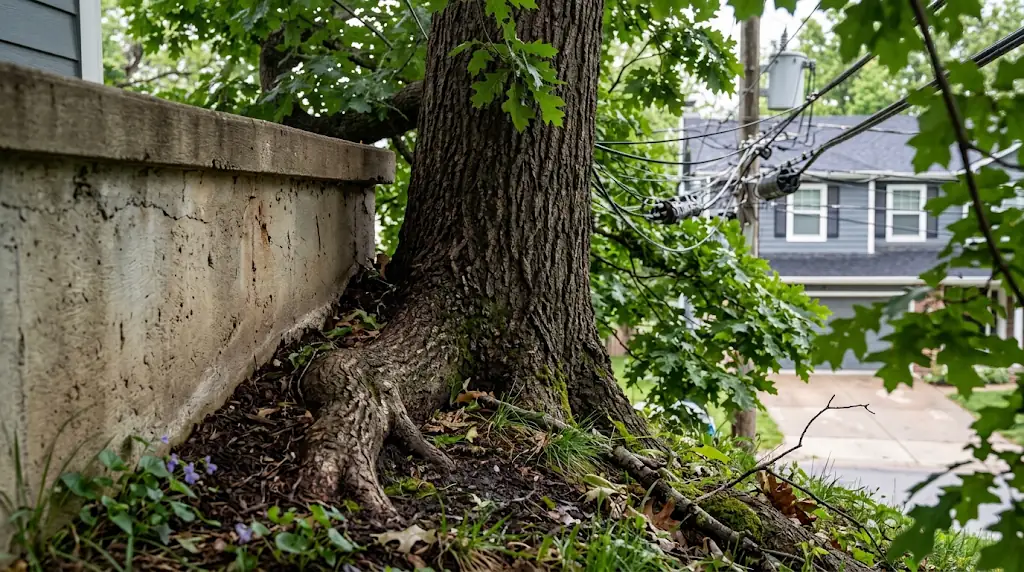
As a general rule, large shade trees should stand at least 20 feet away from home foundations, while branches must maintain a strict 10-to-15-foot radial clearance from overhead utility lines. Violating these thresholds triggers severe foundation settling in heavy Missouri clay soils and creates fire, electrocution, and outage risks along local power grids.
Safe Planting and Clearance Matrix
Matching the mature size of a tree to its physical distance from structural concrete and overhead wires prevents expensive structural remediation or forced utility removals.
| Tree Size Category | Mature Height & Spread | Minimum Distance from Foundation | Minimum Distance from Overhead Power Lines | Common Local Species Examples |
| Small Ornamental | Under 25 feet | 8 – 10 feet | Allowed adjacent to or under lines (within reason) | Eastern Redbud, Dogwood, Serviceberry |
| Medium Canopy | 25 to 50 feet | 15 – 20 feet | 20 feet horizontal distance | River Birch, Crabapple, Hornbeam |
| Large Shade Tree | 50 to 80+ feet | 25 – 35+ feet | 30+ feet horizontal distance (never beneath lines) | Pin Oak, Bur Oak, Silver Maple, Sycamore |
The Threat to Home Foundations: Missouri Expansive Clay
Tree roots rarely puncture solid, intact poured-concrete foundations directly. Instead, the primary danger in Eastern Jackson County and Northern Cass County is clay desiccation.
- The Soil Sponge Effect: The soil throughout Lee’s Summit, Raymore, and Grandview contains high concentrations of expansive smectite clay. This clay swells significantly during wet springs and shrinks dramatically during dry summer droughts.
- Moisture Depletion: A mature oak or maple can pull upwards of 100 gallons of water per day from the surrounding dirt during peak July heat. When planted within 10 to 15 feet of a basement wall, the root system pulls moisture unevenly from underneath the footings.
- Differential Settlement: As the soil beneath one corner of the house shrinks faster than the rest, the foundation drops unevenly. This leads to stair-step foundation cracks, sticking exterior doors, cracked drywall, and compromised basement waterproofing seals.
- Plumbing and Drain Lines: Older clay tile sewer lateral lines—common in older neighborhoods across Independence and Raytown—are vulnerable. Tiny root hairs penetrate hairline pipe joints seeking water, expanding within the pipe and causing catastrophic sewer line backups.
Power Line Clearance Rules: Evergy vs. Independence Power & Light (IPL)
Utility providers enforce strict vegetation management protocols to avoid outages and structural fires. Clearance obligations depend strictly on whether the line is a main distribution wire or a private residential service drop.
Primary Distribution Lines (High-Voltage Street Lines)
- Evergy Service Territory (Lee’s Summit, Blue Springs, Raymore, Grandview, Raytown, Lake Lotawana): Evergy maintains a rolling multi-year pruning cycle. Branches must maintain at least a 10-foot buffer from primary wires. Evergy crews perform directional pruning (V-cutting or L-cutting) to redirect limb growth away from circuits.
- Independence Power & Light (IPL Territory – Independence): IPL enforces clear municipal policy guidelines requiring a minimum 15-foot side clearance from high-voltage electric lines. Overhanging limbs or trees growing directly under main distribution circuits are systematically trimmed or removed entirely.
Private Service Drops (The Wire to Your House)
- Homeowner Responsibility: The low-voltage overhead service line running from the street transformer pole directly to the weatherhead on your roof is private property. Neither Evergy nor IPL will prune or remove trees threatening this specific drop as part of routine maintenance.
- Safety Disconnects: Homeowners must hire a private, insured tree care service to clear limbs near service drops. In Independence, IPL dispatch will temporarily drop the service wire free of charge so private tree crews can fell hazardous limbs safely. Evergy provides similar temporary disconnect coordination upon scheduled request.
Local Municipal and Neighborhood Realities
Lee’s Summit
Neighborhoods with expansive walk-out basements (like those in Raintree Lake and Lakewood) face structural foundation shifts if fast-growing willows or silver maples are planted along downhill footing grades.
Blue Springs
Frequent utility-corridor maintenance occurs around dense residential subdivisions off 7 Highway. Homeowners with legacy trees encroaching on back-easement power lines face aggressive directional cuts by utility line crews if limbs breach the 10-foot safety barrier.
Independence
Because IPL requires 15 feet of line clearance, large canopies on narrow historic lots (such as those near the Truman Historic District) frequently suffer severe canopy loss during municipal trims. Removal and replacement with utility-friendly ornamentals is often more structurally sound than repeated heavy pruning.
Raymore
In Cass County subdivisions like Creekmoor, expansive clay causes foundation movement on newer monolithic slab and poured basement foundations. Planting large oaks inside developer front yards closer than 15 feet from exterior foundation walls regularly voids private structural builder warranties.
Lake Lotawana
Steep lot grades and rocky shorelines complicate both power drop routing and root spread. Shallow bedrock forces tree root plates to spread laterally rather than downward, bringing shallow root networks into conflict with foundation piers, septic absorption lines, and underground electric feeds.
Raytown
With homes built largely between 1950 and 1975, clay tile sewer connections remain widespread. Large sweetgum, silver maple, and elm trees situated between the home’s perimeter foundation and the street curb frequently compromise these aging drainage lines.
Grandview
Properties bordering the Highway 71 corridor frequently feature mature, unmanaged timber along perimeter easements. Heavy ice storms stress branches overhanging secondary power feeds, pulling weatherheads directly off older homes.
Warning Signs a Tree Is Too Close to Your Structures
- Cracking or Uplifting: Pavement, patio slabs, or sidewalk pads within 10 feet of the trunk show distinct vertical heaving from secondary root thickening.
- Interior Wall Cracks: Hairline cracks radiating diagonally from the corners of window frames and doorways during the heat of July and August indicate localized soil shrinkage beneath footings.
- Branch-to-Structure Contact: Limbs touching gutters, shingles, or siding provide direct pest runways for carpenter ants and squirrels, while wind movement scours protective granules off asphalt shingles.
- Arcing or Swaying Near Wires: Any tree limb that makes contact with an overhead electric line during high winds or heavy rainfall creates visible electrical arcing, flashing, or localized power surges.
If an overgrown, aging tree is crowding your foundation, threatening your roofline, or encroaching on overhead power lines, do not attempt to clear it yourself. Contact Lee's Summit Tree Removal today through our contact page to schedule a professional on-site clearance and hazardous tree evaluation.